Planning & Fit-Out · November 2026 · 8 min read
Before the Walls Close: A Smart Home Pre-Wire Checklist for Dubai Villas
Dubai is building at an extraordinary pace. New villas in Tilal Al Ghaf, Dubai Hills and The Valley. Full renovations in Jumeirah, Emirates Hills and the Palm. Fit-out companies working to tight programmes and handover dates.
In almost every one of those projects there is a moment when the walls are open, the ceilings are down and anything is possible. Then the plasterers arrive, and that moment is gone.
What you put in the walls at that stage decides what your home can do for the next 20 years. Cable is cheap. Opening a finished Venetian plaster wall to add one is not.
This checklist is for homeowners, designers, fit-out contractors and MEP consultants. It covers what to plan, room by room, before first fix.
Step 1: Bring the integrator in early
The most common mistake we see is calling the smart home company after the electrical drawings are approved and first fix has started. By then, the back boxes are in the wrong places, there is no room for a rack and nobody has run data cable to the TV positions.
Ideally, your integrator sits alongside the architect, interior designer and MEP engineer from the concept stage. That way lighting circuits, AC zones, curtain pockets and joinery details are all designed with control in mind.
Step 2: The equipment rack
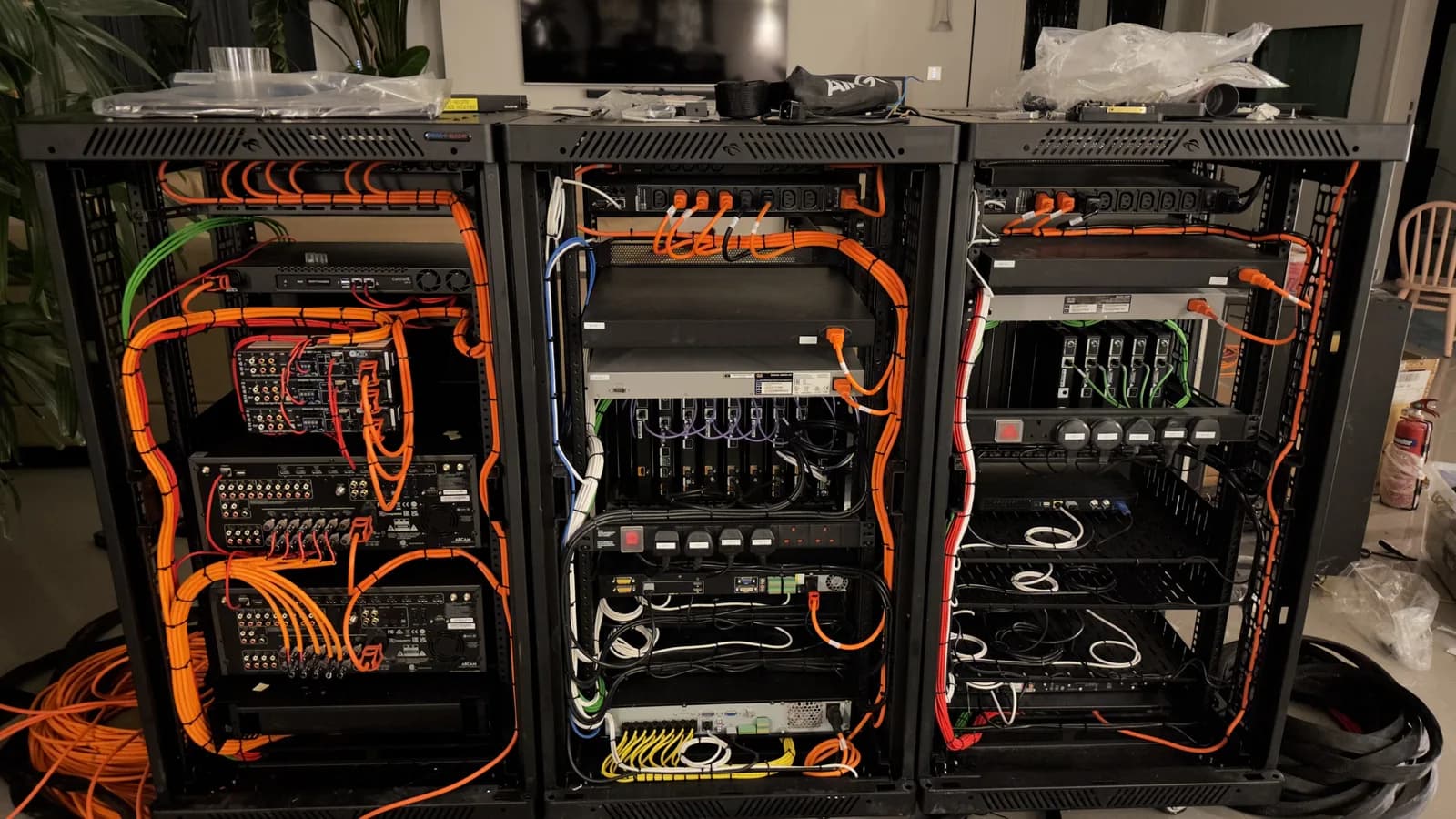
Everything comes back to the rack, so plan it first.
- A dedicated cupboard or small room, central to the house
- Around one metre deep, with access to the front and back
- Dedicated power circuits, ideally on a UPS
- Ventilation and cooling. In Dubai, assume active cooling, not just a louvred door
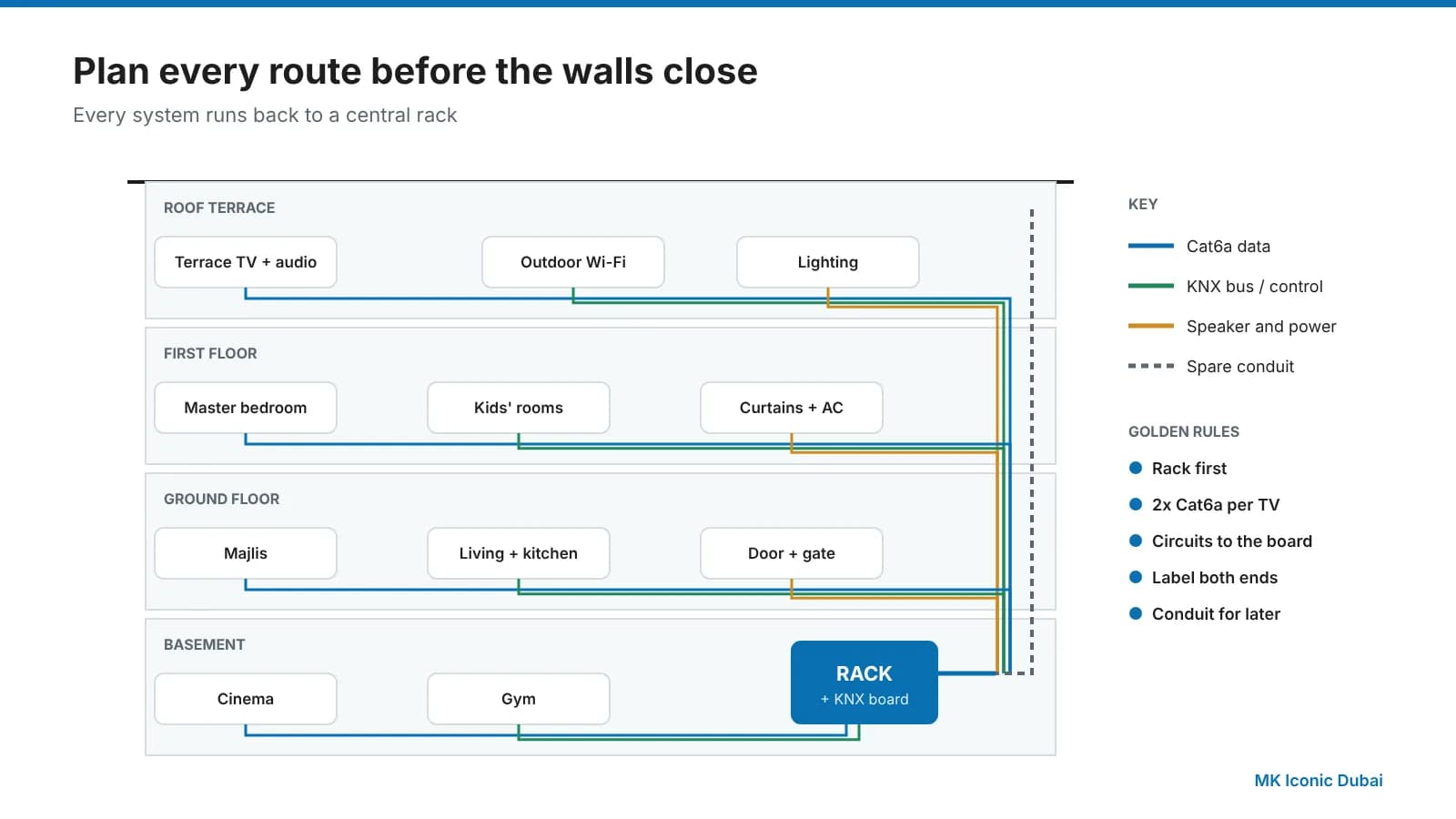
- Containment from every floor arriving at the rack
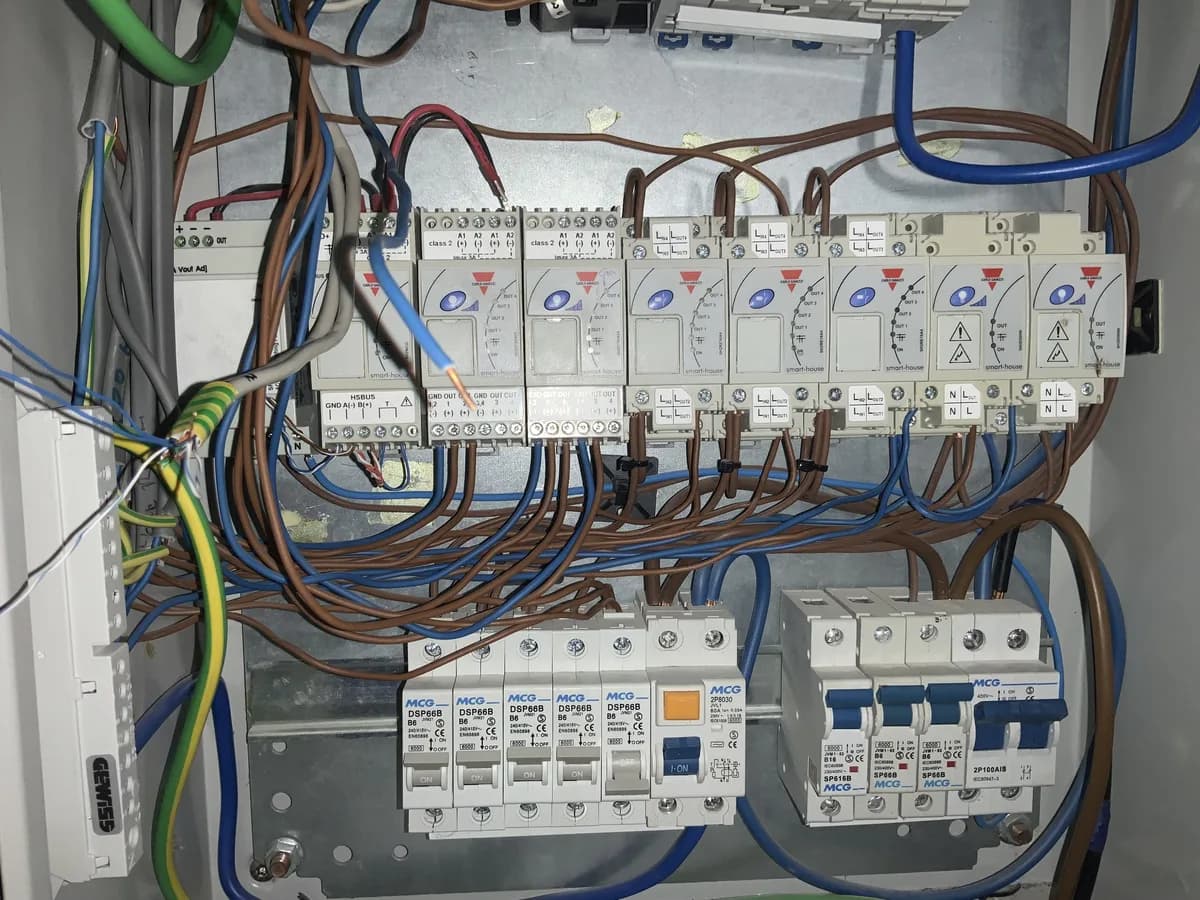
- Space for the KNX distribution board and lighting control panels nearby
Large villas, estates with guest houses and homes with a separate cinema often need a second rack. Plan the link between them with spare capacity.
Step 3: Network and structured cabling
The network is the foundation of every modern home. Get it right and everything else is easier.
- Cat6a to every TV position (at least two)
- Cat6a to every Wi-Fi access point position in the ceiling, roughly one per main room
- Cat6a to every CCTV camera, door station and gate
- Cat6a to every touch panel and control position
- Data points in the study, desks and any home office
- Outdoor access points for the garden, pool and terrace
- Fibre or Cat6a link to any outbuilding, majlis or guest villa
- Spare conduit from each floor back to the rack
Step 4: Lighting and lighting control
Lighting control has the biggest effect on how a home feels every day.
- Agree the lighting design and circuit schedule with your integrator
- Decide on the platform: wired KNX or Lutron, or a wireless system for retrofit areas
- Route lighting circuits back to the distribution board for central control, rather than looping through switches
- Specify LED drivers that are compatible with the dimming method (DALI, phase, 0-10 V)
- Mark keypad positions at the right height and away from door swings
- Run cable for LED strips in coves, joinery and stair treads
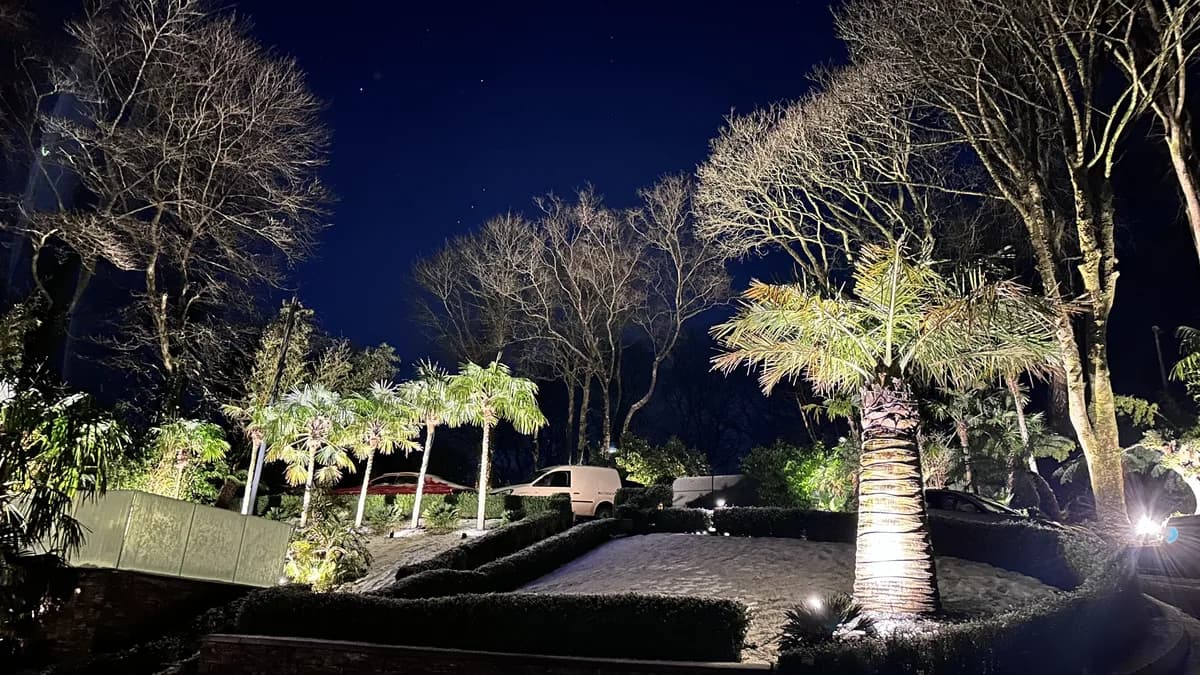
- Include landscape and facade lighting circuits
Step 5: Air conditioning and climate
In Dubai, climate control is not a luxury. Integrating it properly saves energy and makes the house far more comfortable.
- Confirm the AC system type (VRF, ducted split, chilled water fan coils) with the MEP engineer
- Specify the right KNX or BMS gateway for each system
- Plan room temperature sensor or thermostat positions away from sunlight and supply grilles
- Add window contacts on terrace doors so AC can switch off when doors are left open
- Consider humidity sensors in basements, gyms and cinemas
Step 6: Shading and curtains
Motorised curtains and blinds are standard in most new luxury villas here. They also cut solar gain dramatically.
- Agree curtain pocket sizes with the interior designer
- Run power and control cable to every motor position
- Decide whether shades should respond to the sun automatically
- Include external shading or pergola motors on terraces
Step 7: Audio and video
- Agree TV sizes and positions early, so joinery and back boxes are correct
- Run Cat6a from every TV to the rack for distributed video
- Run speaker cable to in-ceiling speaker positions in each room
- Plan outdoor speakers for the garden and pool, with suitable marine-grade products
- For a cinema, involve the integrator in room layout, acoustics and seating before the room is built
Step 8: Security, access and intercom
- Cat6a to all CCTV positions, including the gate, driveway and boundary
- Video door station at the main door and gate, with an indoor station or touch panel
- Cabling for gate and garage door control
- Door contacts and motion sensors if an alarm is required
- Smart lock positions on main doors, agreed with the joinery supplier
Step 9: The rooms people forget
- Majlis. Often the most-used entertaining space. Plan scenes for different gatherings, plus audio and a large screen.
- Maid's and driver's quarters. Network coverage and intercom.
- Roof terrace. Lighting, audio, a screen and Wi-Fi coverage.
- Gym. Screen, audio and good AC control.
- Garage. Network, gate control and an EV charger circuit.
- Plant room. Leak detection and monitoring of pumps and tanks.
Step 10: Documentation
Insist that every cable is labelled at both ends, and that you receive as-built drawings, schedules and test results at handover. Without these, any future change becomes guesswork.
Already finished the build?
Do not worry. Wireless systems such as Lutron RadioRA 3 were made for this situation. In-line modules can be concealed in ceiling voids or behind joinery, close to the loads they control, and keypads fit standard back boxes. In one Green Community villa we pre-programmed and commissioned a full RadioRA 3 system that was physically installed by the client's own electrician.
The choice is narrower than at first fix, but a lot is still possible.
How we work with developers and fit-out contractors
We work directly with homeowners and alongside interior designers, fit-out companies and MEP consultants on new builds and renovations across Dubai. We provide design drawings, cable schedules, rack layouts and lighting control schedules your contractors can build to, and we attend site at key stages to check first fix before the walls close.
We are a Control4 Diamond Dealer in the UAE, a Crestron dealer and a KNX Partner, and every engineer in our team is a certified Lutron engineer.
About to start a build or renovation? Book a site survey and we will help you plan it properly from day one.
Questions we get asked
When should I bring in a smart home integrator?
At concept or early design stage, before electrical drawings are finalised. The ideal time is before first fix, when cables and back boxes go into the walls and ceilings.
What cable should I run for a smart home?
Cat6a data cable to every TV, access point, camera and control position, KNX bus cable for lighting and climate control, speaker cable for audio, and conduit for anything you may want to add later.
Can I add smart home features after the fit-out is finished?
Yes, using wireless systems such as Lutron RadioRA 3, but the options are narrower and the result is rarely as clean. Planning during the build gives the best result for the lowest cost.
How much space does an equipment rack need?
A typical villa rack needs a cupboard or small room around one metre deep with access front and back, dedicated power, ventilation and cooling. Larger homes may need more than one.