WhatsApp us

Commercial · Projection · Dubai

projectors and projection screens for offices in Dubai

When the room is too big for a screen, project.

Flat panels have taken over most meeting rooms, and rightly so. But there is a point where a panel is not big enough, or the price of one that is becomes absurd. Large training rooms, auditoria and town hall spaces are where projection still wins, and where it has to be designed properly to compete with Dubai daylight.

We design projection for offices: laser projectors, throw distance and lens choice, ambient-light-rejecting screens, and motorised screens that drop as the lights dim and the blinds close. One scene, one button, and the room is ready.

Book a site surveyWhatsApp us
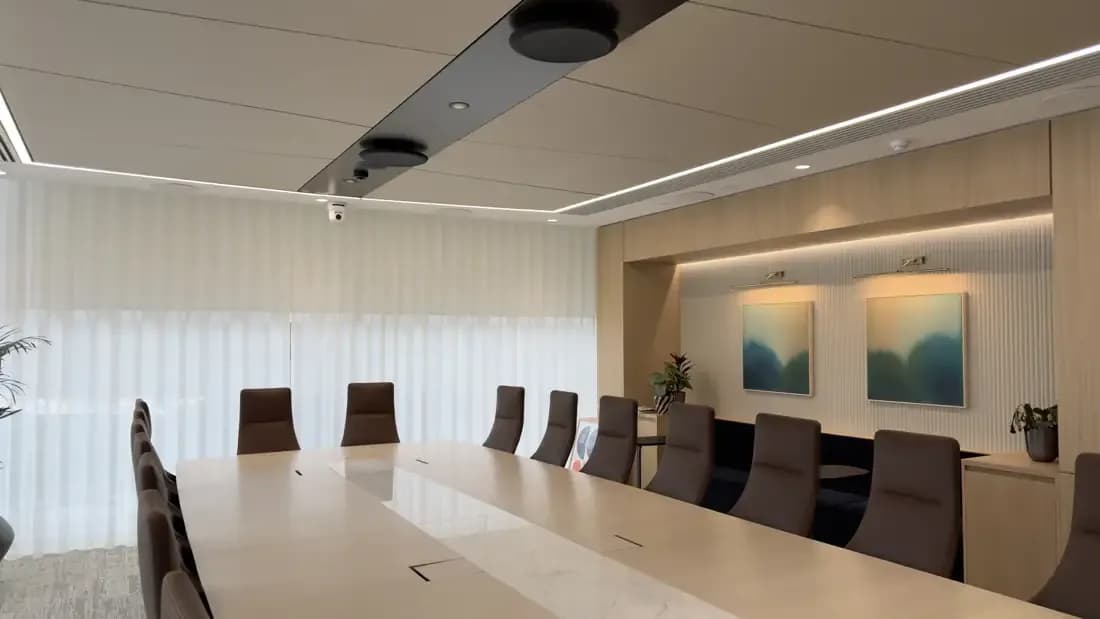
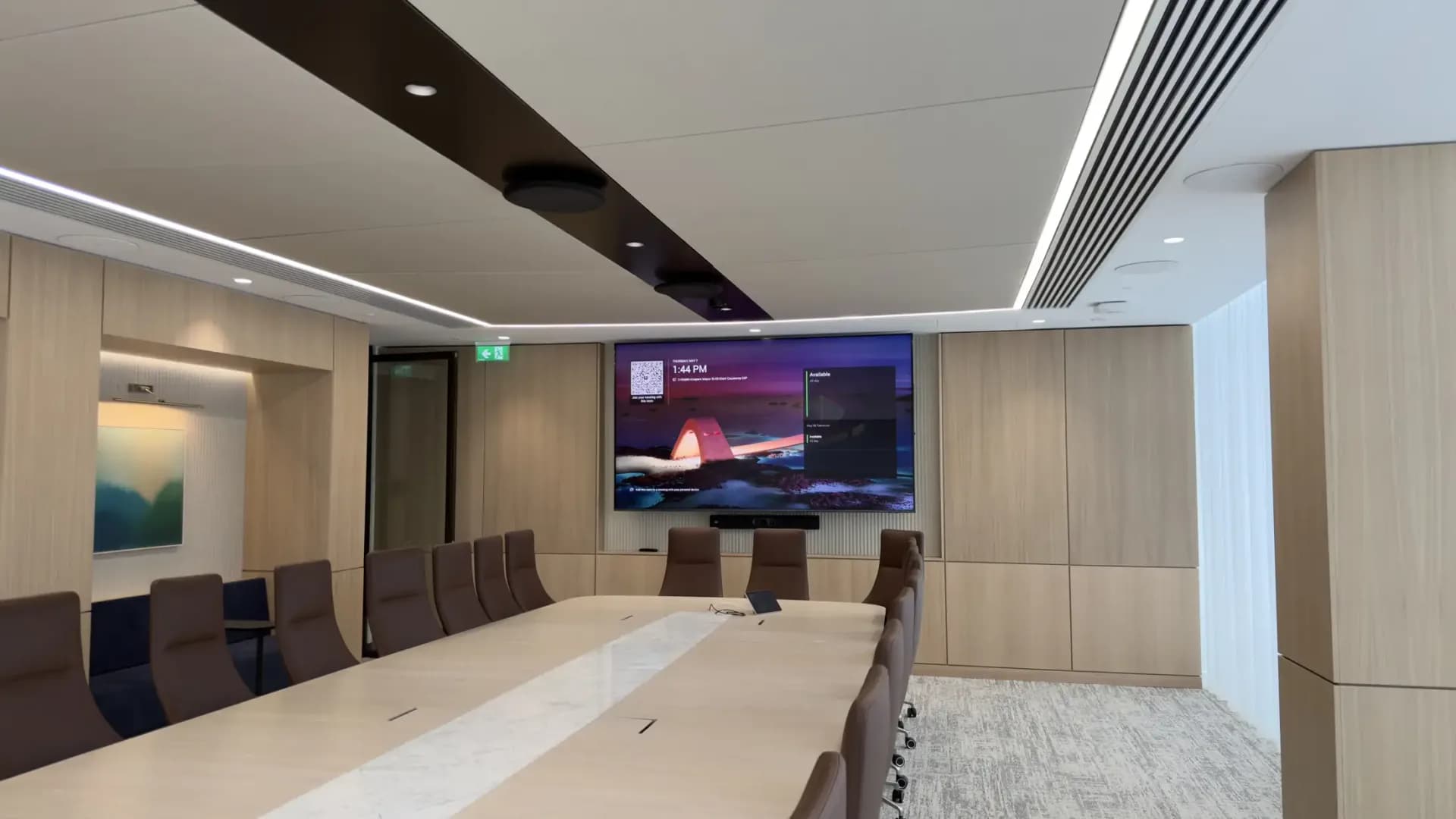
Meeting room with a projection screen and a conference table

Who this is for

Rooms where the back row matters as much as the front.

  • Training rooms for 20 to 60 people where the image must be readable from the last row
  • Auditoria and lecture spaces in corporate headquarters and institutions in Dubai and Abu Dhabi
  • Town hall and all-hands spaces, often open-plan or double height, where a panel would look small
  • Boardrooms that want a large image with no screen on show when the room is not in use
  • Hotel meeting and banqueting spaces that change layout daily and need a screen that disappears
  • Fit-out contractors who need the projector position, screen recess and power on the ceiling drawings early
What MK Iconic does

How we design a projection room

Decide whether to project at all

We start by checking a flat panel or a video wall. If the far seat can read a panel of sensible size, that is the answer. If the room is deep, the ceiling is high or the image must be very large, projection is the better and often the cheaper route.

Light, throw and screen

We measure the ambient light, including the glass, and choose the projector brightness and the screen to beat it. Throw distance and lens set where the projector sits and whether it needs a recess or a lift. The screen size comes from the far seat, the same rule we use for displays.

Integrate with the room

A motorised screen is wired into the room's control, so a Presentation scene lowers the screen, dims the lights to a level that keeps the image punchy, closes the blinds and switches the projector on. Lutron handles lighting and shading, Crestron handles control, and the user sees one button.

Commission and maintain

We align the image, calibrate colour and brightness for the room and test from the back row. Laser projectors have no lamp to change, so maintenance is filter cleaning and firmware. Iconic Care™ monitors the room and logs any fault reported by WhatsApp, email or phone as a ticket.

What goes into a projection design

Laser projection

Lamp-free light source

  • Laser light sources run for years without a lamp change, which matters in a ceiling you do not want to open
  • Brightness is chosen for the room's ambient light, not the catalogue maximum
  • Instant on and off, so the room is ready when the scene is recalled
  • Quieter cooling than lamp projectors, important in a room full of microphones

Ambient-light-rejecting screens

For bright rooms

  • An ALR screen reflects the projector's light to the audience and rejects light from windows and ceiling fittings
  • It lets a training room keep some lights on for note-taking without the image washing out
  • Fixed-frame ALR screens suit rooms where the screen is permanent
  • The screen gain and viewing angle are matched to how wide the seating is

Motorised screens

Screens that disappear

  • Ceiling-recessed screens drop from a slot in the ceiling and vanish when the room is in another mode
  • Tab-tensioned screens stay flat, which matters for text and drawings
  • Integrated with Lutron lighting scenes so the lights dim as the screen lowers
  • Controlled from the same Crestron touch panel as the rest of the room, with no separate remote to lose

Throw distance and placement

Getting the geometry right

  • Standard, short-throw and ultra-short-throw lenses let the projector sit where the ceiling allows
  • A ceiling recess or a lift hides the projector when the room is not in use
  • Edge blending joins two projectors for very wide images in auditoria and town hall spaces
  • Keystone is avoided by placing the projector correctly, not corrected in software

What we work with

LASER PROJECTIONALR SCREENSMOTORISED SCREENSCRESTRON CONTROLLUTRON SCENES

Questions

Projection for offices: questions we get asked

When does projection beat a flat panel?

When the room is deep enough that a panel the far seat can read would be very large and very expensive, or when the image needs to be wider than any panel. Training rooms for more than about twenty people, auditoria and town hall spaces are the usual cases. For most meeting rooms a flat panel is the better choice and we will say so.

Will the image hold up in a bright Dubai office?

Yes, if it is designed for it. Dubai offices have long daylight hours and a lot of glass, so we measure the ambient light and choose the projector brightness and an ambient-light-rejecting screen to match. Motorised blinds on a Lutron scene bring the light down further when the screen lowers. A projector picked from a catalogue without that work will wash out.

How much maintenance does a laser projector need?

Much less than a lamp projector. There is no lamp to replace, so the routine is filter cleaning and firmware updates, and the light source is designed to last for years of office use. We include projectors in Iconic Care™ remote monitoring so a fault is reported before the next training session, not during it.

Can the screen and lights work together automatically?

That is the point of integrating them. We wire the motorised screen, the projector, the Lutron lighting and the blinds into one Crestron control system, then write scenes: Presentation lowers the screen and dims the lights, Discussion raises it and brings the lights back, Video Call sets the lighting for the cameras. The user presses one button on the touch panel.

Tell us about the room and how many people need to see the screen.