Smart Home · October 2026 · 7 min read
Dealer-Based Systems vs Open Source: Choosing a Smart Home Platform That Lasts
Spend any time on smart home forums and you will meet passionate advocates of open-source platforms, Home Assistant above all. They will tell you it can control almost anything, it costs nothing to license and you are never locked in to a dealer.
All of that is partly true. Home Assistant is an impressive piece of software built by a huge community, and we respect it.
But when Dubai homeowners ask us whether they should run their villa on it, our answer is usually no. Not because open source is bad, but because a family home has different needs from a hobby project. This post explains why.
What we mean by each
Open-source platforms such as Home Assistant are free software you install on your own hardware. A community writes integrations for thousands of devices. You, or whoever installs it, are responsible for setting it up, updating it and fixing it.
Dealer-based platforms such as Control4, Crestron and Lutron are designed, tested and supported by a manufacturer, and sold only through trained, certified dealers. KNX sits slightly differently: it is an open international standard, supported by hundreds of manufacturers, but designed and programmed by certified KNX partners using professional tools.
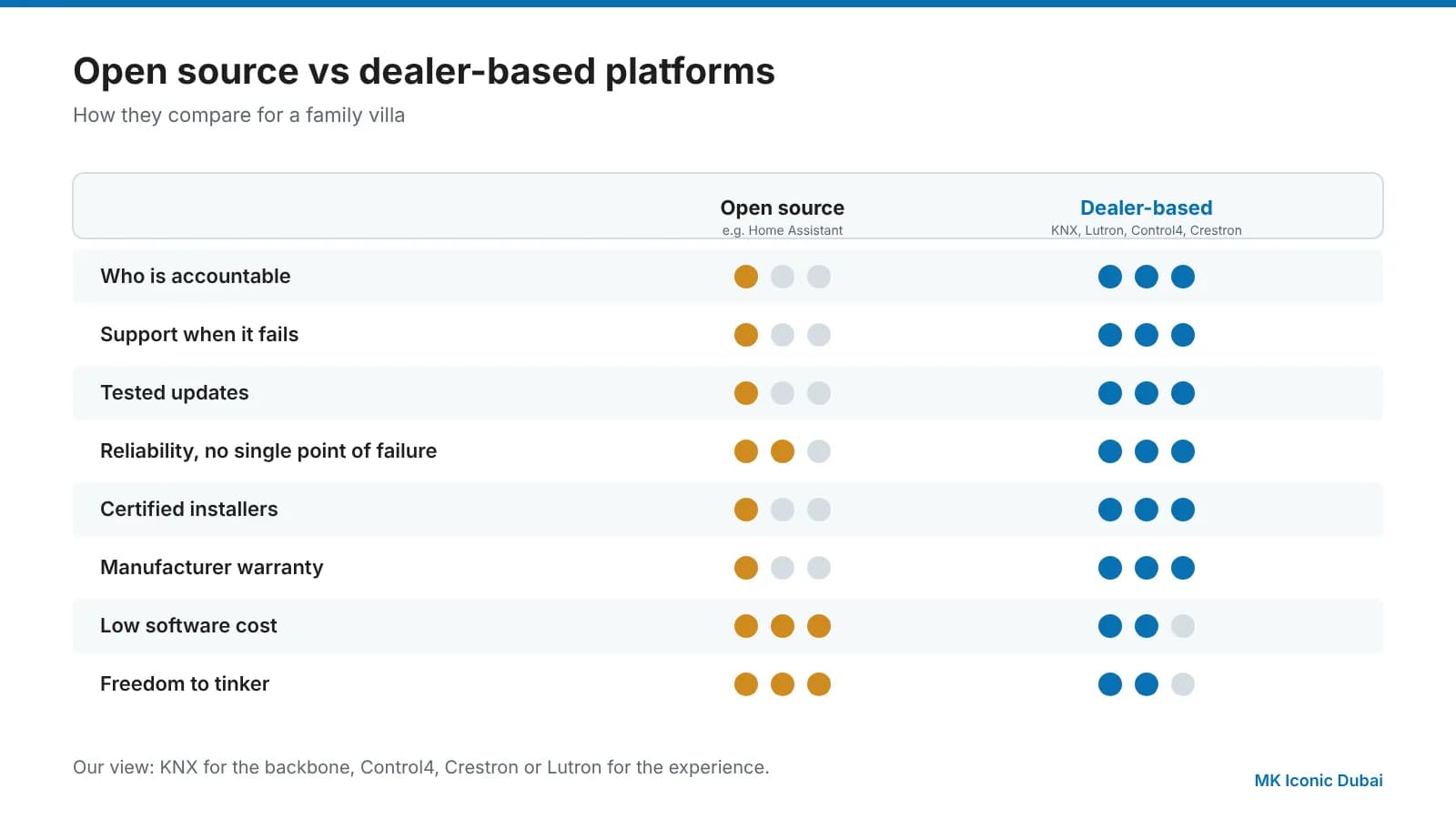
1. Who is accountable?
This is the heart of it.
With an open-source system, there is no manufacturer standing behind the whole thing. If an update breaks your lighting integration, you post on a forum and wait. If the person who built your system moves on, the knowledge goes with them.
With a dealer-based system, there is a chain of responsibility. The manufacturer tests the hardware and software together. The dealer is trained and certified to install and program it. If something fails, there is a warranty, a support line and, with a good dealer, an engineer who knows your system.
For a villa where the lights, air conditioning, security and gates all depend on it, that chain matters.
2. Updates: frequent vs tested
Home Assistant releases a new version every month. That pace is part of what makes it exciting, but every update can change how integrations behave. Enthusiasts enjoy keeping on top of it. Most families do not.
Dealer platforms release updates less often, after testing them against their own hardware. A dealer then decides when to apply them, usually during a planned maintenance visit, and keeps a backup in case anything needs rolling back.
3. Reliability under pressure
A smart home in Dubai is not tested by a quiet Tuesday. It is tested by a power cut in August, an internet outage during a family gathering, or a house manager trying to set up the majlis for 40 guests.
Professional platforms are built for that:
- KNX is wired and decentralised. Each device carries its own logic, so there is no single computer that can bring the whole house down.
- Lutron lighting runs locally on its own dedicated radio or wired network, built for decades of daily use.
- Control4 and Crestron run on purpose-built controllers, not a small hobby computer in a cupboard.
An open-source system can be made reliable, but it takes deep expertise, careful hardware choices and constant attention. When it is all running from one small box, that box becomes a single point of failure.
4. Integration with premium equipment
The best lighting, shading, audio and climate equipment is designed to work with professional platforms. Manufacturers write and certify drivers for Control4 and Crestron, and KNX devices interoperate by standard.
Open-source integrations for the same equipment are usually written by volunteers, often by reverse engineering. They can be excellent, but they can also break without warning when a manufacturer changes something.
5. The lock-in question
The strongest argument for open source is freedom. Nobody wants to be held hostage by one installer.
It is a fair concern, and it is why choosing the right dealer matters as much as choosing the right platform. With Control4, ownership of the system can be moved to another authorised dealer through the app or the Control4 website. With KNX, the project file can be opened by any certified KNX partner.
At MK Iconic we go further:
- Every client gets a client portal login with all project files, drawings, backups and passwords.
- Backups are refreshed automatically after every service visit.
- On KNX projects we always leave a copy of the project file on a USB stick inside the KNX panel.
You own your system. If you ever choose to move on, you can.
6. Total cost of ownership
Open source looks free. The software is. But someone still has to design the system, choose the hardware, run the cabling, write the automations, test it, document it and keep it updated. If that someone is you, the cost is your time. If it is a contractor, the cost is often similar to a professional platform, without the manufacturer support behind it.
Dealer platforms carry licence and hardware costs upfront. In return you get tested equipment, certified installers, warranty and a clear path for support over the life of the home.
A side-by-side view
| Open source (e.g. Home Assistant) | Dealer-based (KNX, Lutron, Control4, Crestron) | |
|---|---|---|
| Software cost | Free | Included in system or licensed |
| Who installs it | Anyone | Trained, certified professionals |
| Support | Community forums | Manufacturer and dealer |
| Update cycle | Monthly, user-managed | Tested, dealer-managed |
| Warranty | Hardware only, if any | System hardware and manufacturer support |
| Documentation | Depends on installer | Standard project files and backups |
| Best for | Enthusiasts, labs, small projects | Family homes, villas, estates, hospitality |
Where open source fits
Open source is brilliant for learning, experimenting and small projects. Some of our most technical clients run it in a study or garage for their own projects. We are happy to provide documented, supported interfaces from the main system so they can do exactly that, without risking the lights, climate or security of the whole house.
Our recommendation
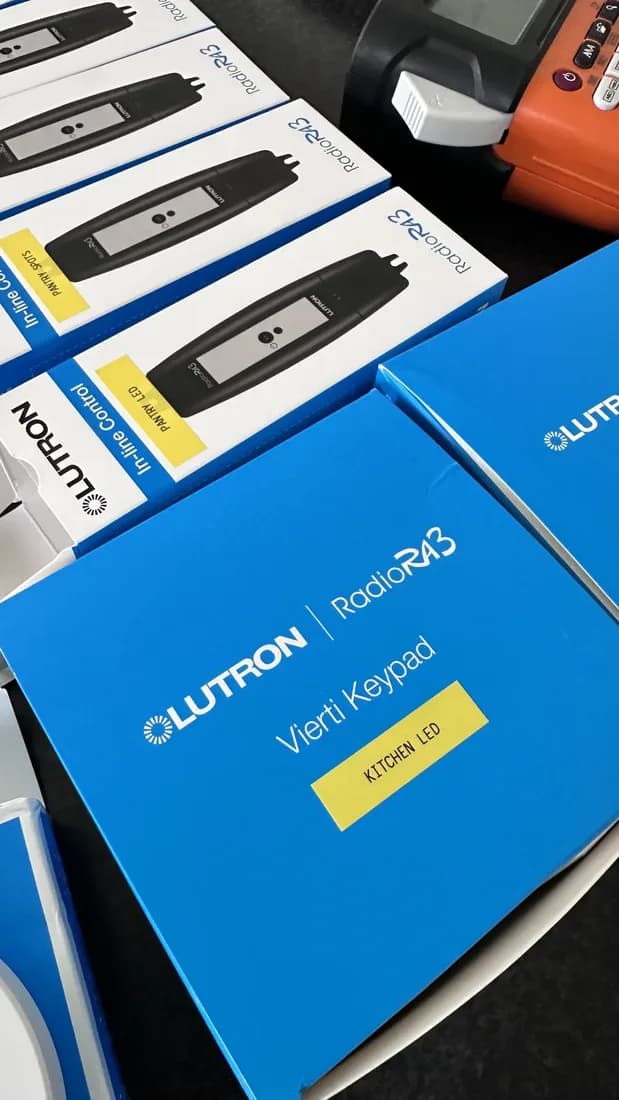
For clients who care about reliability and longevity, we recommend KNX for the backbone, with Control4, Crestron or Lutron for the experience. KNX gives you a robust, wired foundation for lighting, climate and shading that any certified partner can support. Control4, Crestron and Lutron give you the beautiful keypads, touch panels, apps and entertainment control that make it all feel effortless.
We are a Control4 Diamond Dealer in the UAE, a Crestron dealer, a KNX Partner, and our whole engineering team are certified Lutron engineers. We were also responsible for programming and commissioning one of Dubai's first Lutron RadioRA 3 systems, in a Green Community villa.
Choosing a platform for your home? Book a consultation and we will help you choose the right one for how your family lives.
Questions we get asked
Is Home Assistant good for a luxury villa?
Home Assistant is an impressive open-source platform and great for enthusiasts. For a family villa where reliability and long-term support matter, we recommend a dealer-supported platform such as KNX, Lutron, Control4 or Crestron, because someone is accountable for it working.
Does a dealer-based system lock me in to one installer?
Not with a good dealer. Control4 lets owners move to another authorised dealer through the app or website, and at MK Iconic we hand over all project files, backups and passwords on the client portal.
Is KNX open source?
No, but it is an open standard. KNX is an international standard supported by hundreds of manufacturers, so you are not tied to one brand. It is installed and programmed by trained KNX partners using professional software.
Do I need an internet subscription for Control4?
Local control of a Control4 system works without a subscription. A Connect subscription is needed only for remote access and some cloud features. MK Iconic includes the first year of Connect as standard.