Lighting · August 2026 · 6 min read
Circadian Lighting in a City of Permanent Summer
Dubai gets world-class daylight & then wastes it indoors. Tunable lighting gives the day its shape back.
The indoor problem
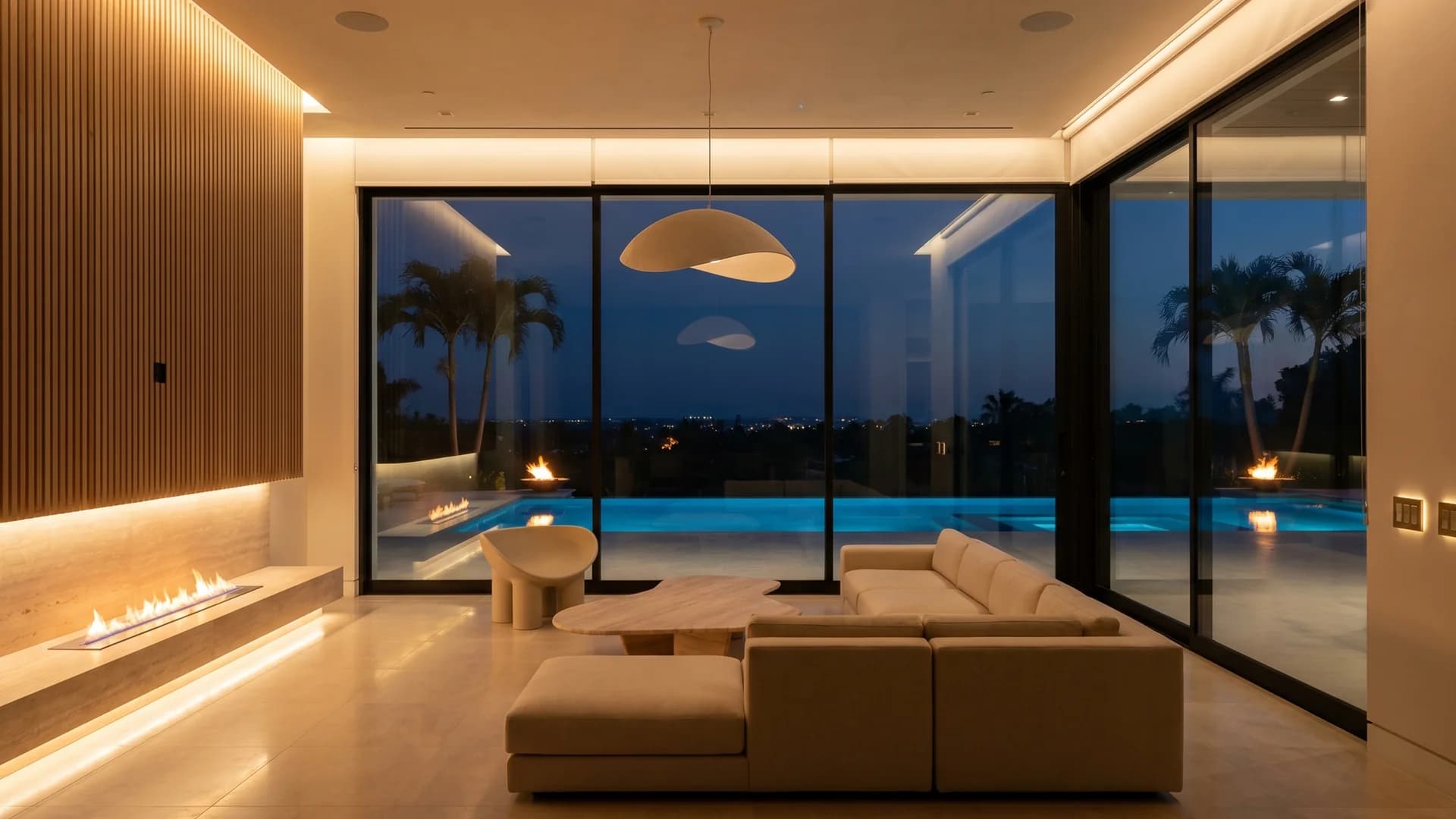
Dubai life happens indoors for much of the year. Tinted glazing, deep shading & air conditioning make interiors comfortable, but they also flatten the light. Rooms sit at the same colour temperature at 9am & 9pm, and the body notices even when you do not.
What circadian lighting does
Tunable-white lighting follows the arc of the day: cooler & brighter through the morning, softening & warming as evening arrives. Run through Lutron or KNX, the shift is gradual & automatic. Nobody programs anything after handover. The house simply behaves.
Paired with automated shading, natural light does the work while the sun is kind & the system takes over when it is not.
A worked example: tunable white in a family villa
A typical scheme in a Dubai family villa: tunable-white downlights and linear LED in the living spaces, bedrooms and kitchen on a Lutron or KNX schedule that runs cooler and brighter through the morning and warms and softens from late afternoon, with a fixed warm evening scene the household can call from any keypad. Nothing is programmed after handover. On RadioRA 3 that is a per-zone cost of AED 2,550 to 5,100; on a HomeWorks or KNX scheme it is designed into the load schedule from the drawings.
Getting it right
Circadian lighting fails when it is an afterthought: one brand of lamp here, another there, colour temperatures that disagree across a single ceiling. It works when it is designed as a layer, with drivers, fixtures & scenes specified together.
We design lighting at the plans stage with your architect & interior designer, so the room is composed once & correctly. The result is not a feature you demonstrate. It is a room that feels right & a night of better sleep.